

🌿 The Many Layers of Forgiveness
Following last week’s newsletter on forgiveness, a reader asked a powerful question: Can we truly forgive if justice hasn’t been served? It’s a question that touches the heart of human experience.
Forgiveness, I believe, has many layers. On the surface, it may seem easier to forgive once justice—at least as we perceive it—has been delivered. But what happens internally in the meantime? And what if that justice never arrives in our lifetime?
When we carry resentment forward, we not only burden ourselves—we contribute to the collective emotional field with a frequency of resistance and pain. This energy influences future experiences, both individually and collectively. Holding onto emotional resistance wreaks havoc on our mental and physical health. It also attracts circumstances that mirror that inner turmoil, perpetuating cycles of suffering.
Forgiveness, however, doesn’t mean inaction. If constructive action can be taken, take it—but do so with clarity and purity of consciousness, free from vengeance or righteous anger. True forgiveness is not passive; it’s a conscious release of emotional entanglement.
It’s the act of letting go—of freeing ourselves from the grip of situations, people, or events that we cannot change in the present moment. This liberation allows us to meet life with greater peace, emotional resilience, and the capacity to act positively in the now. A vibration of peace within us uplifts the field of consciousness in profound and constructive ways.
Evil in the world may defy human understanding. Yet I believe that love—not fear or anger—is the only force capable of transforming it. Fear imprisons. Love liberates. Anger diminishes our power. Love restores it.
Many of us wait for justice before we allow ourselves to forgive. But in truth, this waiting is often a delay tactic of the ego—a way to preserve its sense of separation and identity. Righteous anger is one of the ego’s favourite tools for maintaining the illusion of “me versus the other.”
💫 Self-Forgiveness
There’s one more layer to consider: self-forgiveness. Until we forgive ourselves, we cannot truly forgive others. Our inability to forgive is often a reflection of the unresolved guilt or shame we carry within—consciously or unconsciously. This inner conflict gets projected outward, creating more suffering in our relationships and in the world around us.
Eckhart Tolle expresses this beautifully:
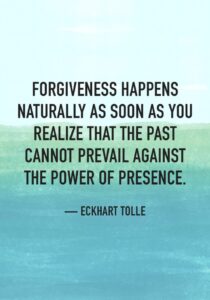
“Forgiveness is to relinquish your grievance and so to let go of grief. It happens naturally once you realize that your grievance serves no purpose except to strengthen a false sense of self (Ego). Forgiveness is to offer no resistance to life—to allow life to live through you.”
And further:
“You cannot truly forgive yourself or others as long as you derive your sense of self from the past. Only through accessing the power of the Now… can there be true forgiveness. This renders the past powerless, and you realize deeply that nothing you ever did or that was ever done to you could touch even in the slightest the radiant essence of who you are.”
Forgiveness, then, is not just a moral act—it’s a spiritual liberation. It’s a return to wholeness.